


TL;DR
The youth mental health crisis is mostly a Western phenomenon. Same smartphones, very different outcomes. East Asia and Eastern Europe didn’t see the same collapse.
The smartphone case isn’t wrong, but it’s been oversold. Screen time explains under 1% of wellbeing variance, less than bullying, sleep loss, or family relationships.
Gen Z is more openly LGBTQ and more therapy-fluent than predecessors. Some of the “crisis” is real distress; some is honest reporting that earlier generations never gave us.
Post-2021 data shows things improving. The boring fix works: guard sleep, move daily, see faces over screens, and don’t slap a diagnostic label on normal sadness.
I like my classroom to be a “safe space” with open dialogues about difficult subjects. Sometimes they’re political things. Other times they’re personal. The biggest benefit, no matter the topic, is connection. We build trust and navigate hard moments together. (Always on cue is the semi-annual mass shooting.)
There’s another little bonus: I get to peek through the blinds and into their lives…in a totally non-creepy kind of way.

Dozens of open dialogues have taught me 2 seemingly contradictory things.
Our kids have healthier behaviors than we did. Anecdotal evidence and hard data both speak to this.
They are less mentally fit than we ever were. Emotional stability. Resilience. Hope. They fare worse on all of these fronts. (For reference, I’m an ’80 baby sitting on the Gen X-Millennial cusp.)
Our youngest adults drink less, smoke less, and screw less. (No wonder they’re so depressed.) Teen pregnancy rates have plummeted by 75% since the 1990s. The kicker? Despite the incessant texting, they’re also safer drivers.
Then, out of left field, comes the frailty. Compared to elder generations, Gen-Z adults are the least likely to be “thriving” (39%, lowest on record). They’re also almost 2X as likely to seek therapy compared to Boomers.
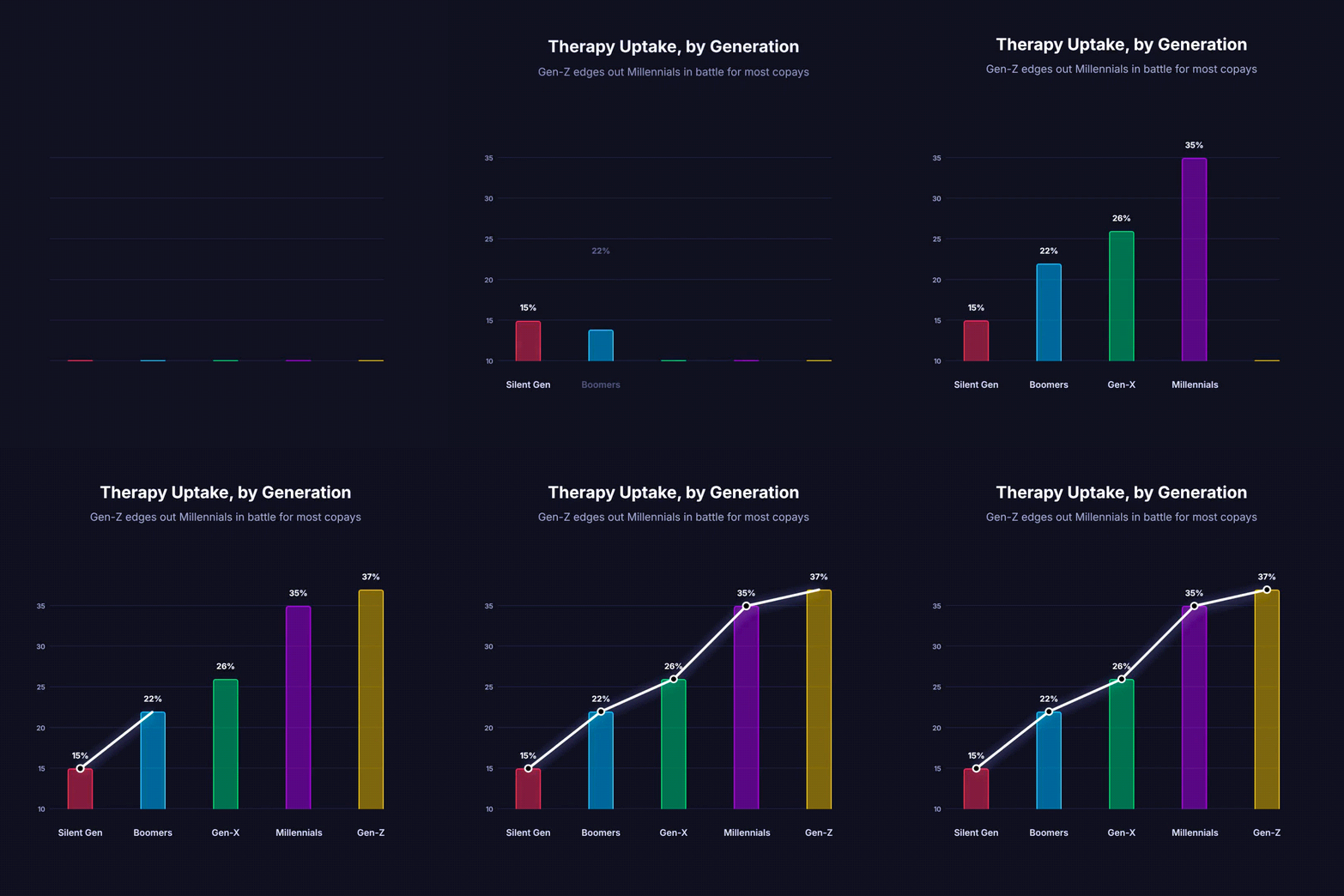
So our kids are showing themselves to be responsible. They’re treating their bodies better. But they’re also more likely to express feelings that things aren’t quite right in their lives. Their quest for answers has compelled them to advocate for their own therapy.
This strikes me as a counter-intuitive mix of decorum and depression. That’s my first thought, anyway. But the more I tossed it over, the more it occurred to me that their relationship with their feelings might not signal a generation in crisis. Maybe—and I know this is a wild thought—they actually have the healthiest relationship with mental health we’ve ever measured. They’re making the right behavioral choices AND freely expressing when they need help.
To find an answer, I delved into the reigning explanations for the youth mental health crisis. And the 4 biggest things I learned might surprise you.
#1: It’s mostly a Western problem
The American Gen-Z data on thriving and therapy is telling. But a global comparison on general happiness adds much-needed nuance.
The US has fallen out of the top 20 happiest countries, mostly driven by a collapse in happiness among people under 30.
The US ranks #23 in overall happiness, but #62 when ranked by its young people alone. To boot, the US ranks #10 for its over-60s population. Same country, two realities.
Jean Twenge and David Blanchflower found the same post-2012 youth decline in the UK, Canada, Australia, New Zealand, Scandinavia, Germany, and France.
Curiously, happiness rose among young people in Central/Eastern Europe, East Asia, and parts of the former Soviet bloc over the same period.
The Twenge and Blanchflower article argues that the “happiness U-curve” has shifted in the Western world. In other words, it used to be high in youth, then dip in middle age before rising again. Now, it’s a flatter line that increases slowly with age.
Most importantly, we can’t pass these trends off as American anxiety over school shootings, fentanyl, or the Netflix crackdown on password sharing. None of those explain why the kids in London and Melbourne started struggling at roughly the same time. Well, except the Netflix thing. That was a universal tragedy.
I’ll dig further into the global differences in #3 below. For now, we can conclude that these countries simultaneously saw a cultural shift that took motion in about 2012. That conspicuous timing has led experts to shovel the blame onto screen adoption, and particularly the smartphone.
#2: The merits (and limits) of the smartphone explanation
Scholars have dusted for fingerprints at the scene of this crime—A LOT. And they’ve landed on the iPhone as a key person of interest. To their credit, youth mental health took a dive right when smartphone adoption hit a saturation point, the 2012 timeframe I just mentioned.
The strongest evidence goes like this:
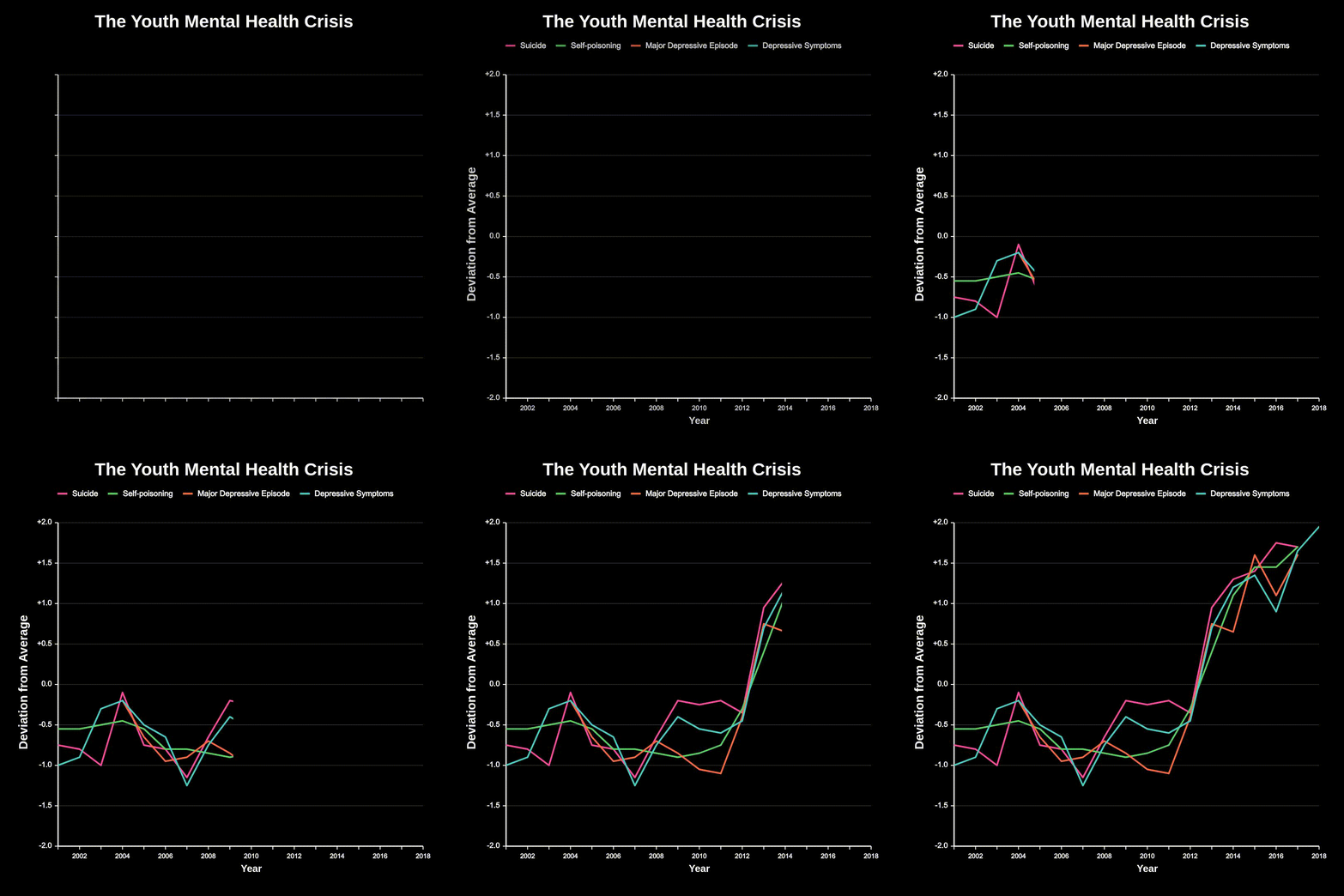
Jean Twenge and colleagues analyzed data on 1.1 million high schoolers from 1991 to 2016. (Creepy much?) They found the teens were doing fine right up until 2012. Then, suddenly, they weren’t. As shown in the chart below, wellbeing fell off a cliff at exactly the moment most teens got their first smartphone. If there’s a smoking gun, this is it.
Twenge grabbed some more homies and did a follow-up study. When they added national suicide data, the authors noted sharp rises in depression, suicidal thoughts, and suicide deaths starting around 2010, especially among girls. They specifically tested and ruled out the obvious economic explanations (unemployment, stock market, etc.). The money parts didn’t track with the changes, but screen time did.
From there, Twenge went rogue, doing a solo study in 2020. In that piece, she pulled together the evidence and laid out some proposed mechanisms. She argued that phones eat sleep, replace face-to-face contact, and amplify social comparison (the last one being especially damaging to teen girls).
Pretty airtight—right?
Well, kinda. It’s at this point that iMessage addicts rushed to the defense of the smart phone. (Hot conspiracy take: They were on Apple’s secret payroll.)
To start, Amy Orben and Andrew Przybylski poked significant holes in the data. Using large data sets, they found that screen time explains at most 0.4% of variance in adolescent wellbeing. In a fit of fighting words, they made a famous comparison: screen time was as closely associated with wellbeing as eating potatoes or wearing glasses.

These weren’t rhetorical flourishes. They were direct comparisons the authors ran in the same datasets to add context to the screen time effect. And they weren’t done. They also pointed out that other factors had dramatically larger effects than phones:
Being bullied
Smoking marijuana
Sleep loss
Healthy relationships (especially at home)
Then came the direct rebuttal to Jon Haidt’s The Anxious Generation, the 2024 book that effectively placed the smartphone argument on every parent’s nightstand. In her response, Candice Odgers puts out a basic objection: Haidt’s data is mostly correlational and the effects are small. To which Haidt replied, “My effects are average size!”
Odgers doesn’t think people like Twenge and Haidt are completely manufacturing the youth mental health crisis. She agrees that it’s real and requires intervention. But to intervene effectively, we have to focus on causes. And it’s a big leap from “phones are connected to mental health” to “phones are rewiring children’s brains and causing a mental health crisis.”
Going back to the global comparisons, Odgers also pointed out many countries with high smartphone adoption rates didn’t show the same effects, especially in East Asia. Put bluntly, the smartphone adoption thesis cherry picks countries where the timing lines up nicely and ignores the others.
Again, people like Orben, Przybylski, and Odgers aren’t doing an Officer Barbrady impression. They agree that there’s something to see here. They just think the evidence against the smartphone is, at best, circumstantial. At worst, it’s misleading and could lead to unproductive interventions (e.g. phone bans).
SIDE NOTE: As a father of two girls who will one day become tweens and teens, I don’t care if the evidence proves causality. I’m ALL about phone bans and pushing these things back until adulthood. I’ll die on this hill. Then, one day, my girls will trounce on my dead body as they scroll away.
#3: The crisis has a demographic
This is where the Gen-Z and Millennial mental health crises come into focus. Before I dive in, I should make it clear that I’m not saying the smartphone, lack of sleep, and social comparison aren’t real drivers of this phenomenon. But we’re getting an unclear picture simply by pointing at smartphone saturation.
At the risk of tanking your libido, I’m gonna get stats-nerdy. To help, here’s a pic of an ugly guy with his hot wife you can come back to when you get bored.

Any statistician will tell you that survey data is fallible. Just look at the 2016 and 2020 presidential elections for a couple fine examples. To their credit, most of these youth happiness surveys don’t suffer from sample size issues. But the surveyed population does present some problems, meaning that the data is skewed by character traits in the respondents.
First, Gen-Z is vastly different from those of previous generations, both in culture and demographics. Specifically, Gen-Z is far more likely to openly identify as LGBTQ. In fact, there’s a steady cross-generational rise in queer self-identification.

There are two possible explanations:
Gay proselytizers really hit their marketing stride in the early aughts, convincing more straights that being gay is cool.
Acceptance of alternative lifestyles led to more honesty and self-identification in Gen-Z. So it’s not that more people are gay. It’s that they’re more likely openly identify as such.
Despite the mercurial rise of marketing majors, explanation #2 is far more plausible. If true, it indicates that younger generations have shed some weighty stigmas common to their progenitors. Having unloaded that stigma, they no longer fear the judgment associated with honest survey responses. This is likely the case for being gay. The result, potentially, is more honesty and less overall response bias (AKA lying).
Could the same honesty effect also show up for expressing anxiety, depression, or thoughts of suicide?
At minimum, the ascent in LGBTQ identification is a signpost of a generational culture shift. And stats geeks have repeatedly pointed out that culture conditions survey responses. At most, we’re seeing the tip of the iceberg of Gen-Z’s honesty on surveys.
I want to show you why LGBTQ identification likely impacts the overall happiness trends.
People who identify as LGBTQ are 2-6x more likely to experience mental distress.
Persistent sadness is expressed by 65% of LGBTQ respondents, versus just 31% of cisgender peers.
LGBTQ teens are 4x more likely to attempt suicide than straight peers. The highest risk subgroup is bisexual teens with more than a 1 in 4 chance of attempting suicide (27%).
LGBTQ adolescents had 5-6x higher odds of clinical-level depression and 3x higher odds of clinical-level anxiety.
So let’s recap Gen-Z’s cultural artifacts:
They’re more likely to openly embrace alternative sexual identities.
Those alternative sexual identities are linked with higher rates of mental health issues.
They have been acculturated in a therapy-friendly world and view therapy as a positive, legitimate path for addressing problems.
Each of these traits introduces a population bias in the survey data. In other words, Gen-Z’s mental health may be a story of identity and culture, rather than a yarn about a lost generation. On matters of gender and sexuality, it’s clear that Gen-Z’s reality is different from their predecessors. (It’s no wonder Boomers think they’re all batshit crazy.)
But this presents us with a population knot in the “saddest generation” data. It’s possible, compared with previous generations, that they’re just more likely to be honest about many things. These might include sexuality, negative emotions, anxiety, depression, and suicidal ideation.
Let’s zoom back out to the global perspective. You might remember that some countries saw declines in youth mental health while others didn’t. The former group includes the US, UK, Canada, Australia and Western Europe. The latter group is mostly Central and Eastern Europe and parts of East Asia. This creates a consistent cross-national pattern that helps us tease out why identity, culture, and therapy might be causing a divergence between actual wellbeing and measured well-being.
Declines are concentrated in high-LGBTQ acceptance/identity + mature-therapy + housing-squeezed countries. Wellbeing is stable or rising in lower-LGBTQ visibility + recovering-economy countries.
Eastern European story: genuine economic improvement (post-Soviet recovery + EU integration), lower LGBTQ+ visibility and identification, less developed mental health infrastructure, and lower therapy uptake. So even where real distress may be similar, measured distress is lower.
Anglosphere story: stagnant or worsening housing and middle-class conditions for young adults, high LGBTQ+ visibility and identification, mature mental health infrastructure, therapy-saturated. The same underlying distress shows up much louder.
The implication: countries aren’t different because their kids are different. They’re different because their measurement instruments and real economic conditions differ.
It’s possible that young people in Poland are happier than the ones in Portland. (Having been to Portland in December, I could see why.) And maybe contrasting experiences with technology are responsible for this. It’s also possible that their society just hasn’t gotten to the critical threshold of gay acceptance and therapy uptake to reveal the truth.
All of this, for me, places some question marks in the data. But it falls short of delegitimizing the data entirely. There’s clearly something there. It’s the alarmism and phone scapegoating that are arguable.
#4: The problem is real. It’s also getting better (maybe).
There are valid arguments about flaws in the survey data and the limits of the smartphone argument. Despite this, my biggest takeaway is that this problem is very real. Diagnosis rates for youth mental health issues have increased significantly since Gen-Z has come of age.
Whether or not this confirms a mental health “crisis” is arguable. But something’s afoot in the area of youth wellbeing, and many are scrambling to identify causes and fixes. When I say it’s real, I mean one of two things is certain:
Today’s youth are truly less happy.
They’ve become convinced their lives are less happy and perception has become reality.
There’s no need to quibble over chickens and eggs. Not here, anyway. We should just accept the messages coming from the data we have. That data says that Gen-Z feels worse about their lives than any previous generation did at the same age.
If happiness is the measure and surveys are truth-tellers, Boomers win and Gen-Z loses. Big time.

Then comes the last twist in the literature. This very real problem appears to be finding real solutions. In fact, some are saying that the worst has already passed. The strongest indicators have arisen in the post-pandemic era.
CDC data shows improvement from the 2021 peak in the youth mental health crisis. For example, persistent sadness and hopelessness among US high schoolers dropped from 42% in 2021 to 40% in 2023. Among girls specifically, the decline was sharper — from 57% to 53%.
Suicidal ideation among high schoolers fell from 22% in 2021 to 20% in 2023.
Hispanic students showed the clearest improvement, with persistent sadness dropping from 46% in 2021 to 42% in 2023. Suicidal ideation fell from 22% to 18%.
I know, the shifts are small and could just be measurement error. But keep in mind they come on the heels of a decade-long upward trend in depression, anxiety, and all aspects of suicide. Any leveling is a good sign. Only future surveys will tell if it’s a fluke.
Other studies back the notion that we’re seeing improvement. A 2024 global survey by Deloitte revealed that 39% of Gen-Z said their mental health improved in the last year, versus only 18% who said it got worse. Pew data from 2024 said that 48% of U.S. teens now say social media has harmful effects, up from 32% in 2022.
It turns out that maybe, just maybe, the broad adoption of therapy across Gen-Z is working. Are you sensing the irony yet? The same therapy saturation that inflates diagnoses and self-reports is enabling people to get help and address problems.
Boomers had their crises in midlife, following their divorces and steep Mazerati payments. It’s possible that Gen-Z is having their crisis on the front end of life, treating it with vocabulary, tools, and a mental health infrastructure that didn’t exist 30 years ago.
What to do for yourself (or the young people in your life)
I’ve read some “hot takes” that suggest young people need to drink more, smoke more, and fuck more. I refuse to be one of those guys. In fact, the last suggestion I would have for my students (or my kids) is that they rush out to poke holes in their liver while making bad choices. Instead, let’s identify some real solutions based in high-quality research.
Under the noisy academic debate sits a quiet consensus. Every research camp—from the alarmists, to the skeptics, to the developmental psychologists—agrees on the same short list of protective factors.
They’re unsexy, boring, and (at this point) cliched. But they’ll work regardless of your age cohort. Here are four:
Guard sleep like it’s your job. Sleep is one of the strongest predictors of adolescent wellbeing (yep, larger than screen time). In fact, sleep problems significantly explain the phone-to-depression pathway. Sleep loss keeps the amygdala hyperactive (threat detection) while dampening prefrontal regulation. This is the signature of anxiety. Remove the phone from the bedroom and a cascade of other things improves.
Move your body. A meta-analysis of 100+ studies shows physical activity reliably cuts depression and negative affect while raising life satisfaction in youth. Exercise releases BDNF and endorphins, but the more durable mechanism may be giving the body regular rehearsals of doing something hard and finishing it. This is a direct counter to depression’s cognitive loop.
Prioritize faces over screens. Face time is a psychological nutrient that digital “connections” struggle to replicate. This is likely why young people today report having fewer close friends than previous generations. Here’s how much this matters: The Surgeon General’s 2023 advisory puts chronic loneliness on par with smoking.
Resist the diagnostic label when it doesn’t fit. Sometimes you’re sad, not depressed. And a healthy amount of anxiety isn’t crippling. Therapy doesn’t have to be vocabulary prep for your upcoming sadness interview. Everybody has rough weeks, even months. There are valid reasons to avoid pathologizing normal feelings, and research to support this.
Seems like a solid list to me. Though I do have to admit something: The drinking, smoking, and sex sound a lot more fun. I wouldn’t blame anyone who takes that route instead. But that’s probably because I’m a grimy, godless Gen-X’er who’s made more bad choices than Woodstock ’99.