


Show me the money!
Rod Tidwell’s mantra in Jerry Maguire stuck with me. Great movie, an underdog tale about making it in the vicious world of pro sports. There are even character arcs and a love story peppered in. But the main object of desire, other than a youthful Renee Zellweger, is a big payday. (Spoilers: They get paid.)
Jerry Maguire’s narrative captures the essence of American material values. First, it unmasks how we define success (money). Second, it reveals our zealous faith in money, especially that can money buy happiness.
And maybe a fit trophy spouse.

These American values are at odds with what our mothers told us, which is that money can’t buy happiness. So who got it right—movies or mom?
Regrettably, my goal here is to make a liar out of moms everywhere. Here’s why: For most of us, money is likely to produce happiness. Admittedly, the relationship is complex. In fact, the line from money to happiness is more crooked than straight.
Most importantly, I’m about to reveal who money works for and why. With that knowledge you’ll be able to avoid the pitfalls of unhappiness that plague even the richest people.
Side note: “Happiness” here means people’s self-reported moods, feelings, and emotions, communicated through some kind of survey instrument. It’s how you feel in the moment, not how you feel about your life in general.
Money & Happiness: What the Research Says
Luckily, academics have been poring over the money & happiness question for a couple of decades. This gives us a healthy amount of information to work with.
In 2010, Nobel laureates Daniel Kahneman and Angus Deaton published the first highly touted study on money and happiness. They argued that money has a diminishing return on “emotional well-being”, which is your day-to-day experience. As you climbed the income ladder, money’s impact on your daily happiness steadily plateaued, eventually disappearing at about $110k. (Adjusted for inflation from the original figure of $75k in 2010.)
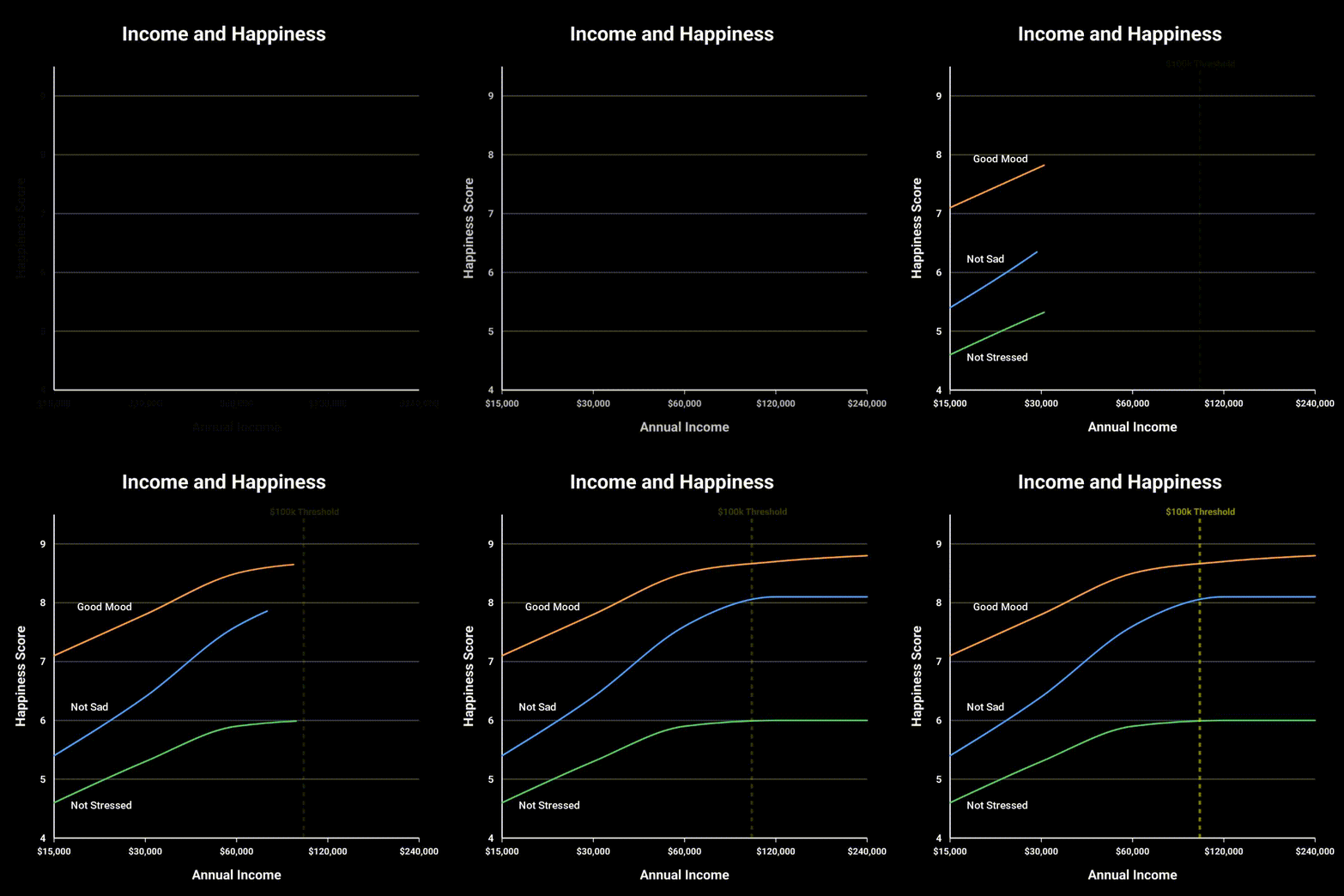
Their main implication is that money does buy happiness, but only if it’s attached to upward mobility from the working class to the upper middle class.
If you’ve ever been poor, you know that this conclusion ranks at the tippy top of the no shit, Sherlock list. Poverty sucks. Getting out of it is uplifting, even joyful.
The Plateau That Wasn’t
This cap on money and happiness was widely cited for years, eventually being called the plateau consensus. But all that changed in 2021, when a cheeky scholar had the gall to drop a knowledge bomb on the Nobel-prize winners.
Matthew Killingsworth—whose name is straight out of a British production of Dexter—amassed a real time data set from 33k U.S. adults, immediately giving Kahneman and Deaton a serious case of data envy.
Killingsworth’s article heavily debunked the plateau consensus, loudly declaring that there was no ceiling to the happiness potential of money. Here’s a visual:

Notice that the line steadily rises with added income. Importantly, Killingworth concluded that the impact of money on happiness ran through 2 avenues: autonomy (control over one’s life) and security (less risk). Autonomy by itself accounted for 74% of the connection between income and happiness.
In other words, money buys happiness mostly because you feel more in control of your life. The sense that you’re less at risk also helps, albeit more subtly.
In a pointed (and direct) rebuttal to Kahneman and Deaton, Killingsworth titled the article “Experienced well-being rises with income, even above $75,000 per year.”
Street translation: your mom.

Resolution (kinda)
Killingsworth and Kahneman committed to a steel cage match to sort out the $75k plateau question. But it was called off when Kahneman didn’t make weight. (Nice job, chubs.) So they shifted gears and teamed up for the study to end all studies.
That piece was published in 2023 and added some much needed nuance to the debate. Here’s what they found (and where things stand):
Results vary from person to person. While income bumps gradually make some people happier, other people experience the plateau (pegged at $100k in this study).
Using real time happiness scores, they separated people into 3 groups; the “unhappy minority” (bottom 20%); the middle 50%; and the happiest 30%.
For the unhappy minority, happiness plateaus at $100k. Whatever joy they’ve reaped from money stops there.
Both the middle 50% and the happiest 30% avoided the plateau. Increases in happiness continued beyond $100k and the curve never flattened.
For the happiest 30%, the money-happiness connection accelerates. In other words, happiness rises faster than it does for the middle 50%. If you’re already a very happy person, money really does buy happiness—and fast.
It turns out your experience of money and happiness depends on—well, how happy you are. So there you go. Happy people get happier with money.
Does this argument seem painfully obvious and possibly cyclical? I thought so, too. At least at first. But the authors explained that it’s a little more complicated than “happy people keep getting happier.” Instead, they’re saying that happy people are better at turning financial wealth into exponential joy. Or, from the other side, that unhappy people are mired in their melancholy, regardless of what money comes their way.
Why Money Makes Some People Happier Than Others
At this point, the biggest unanswered question is, why do the happiest 30 experience money differently? If we know the answer, we can tiptoe around the unhappy minority pitfalls and try to mimic the lives of the happiest 30.
Killingsworth and the gang take a purely statistical approach. For them, the unhappy minority are those who frequently experience “negative affect”, the industry term for feeling cranky. The happiest 30, in contrast, rarely report negative affect and frequently report positive emotions. The middle 50 sit somewhere in between.
Basically, the first (and most unsatisfying) differentiator between happy and unhappy is being in a bad mood vs. a good mood. That’s as far as they took it.

Thankfully, other studies give strong clues about the comorbidities of negative affect. Here are the highlights:
High neuroticism
Chronic stress (financial, time, work, etc.)
Chronic illness/pain
Social isolation
Strained/failing relationships
As far as I can tell, the neuroticism part is neurological and often genetic. Their nervous systems generate more threat signals and they get less pleasure from positive experiences. So even a windfall doesn’t register the same way.
The rest of the list qualifies as circumstantial. In short, the unhappy minority is either genetically hapless or situationally deprived. And the situational parts are complicated. Some are changeable. Others are avoidable. Many are neither. (Like chronic illness/pain.)
What’s more interesting are the ways that happier rich people use their money. Take a look at how this list compares to the one above:
They buy time (less time stress)
They spend prosocially (on others)
They prioritize experiences over things
They align spending with values and purpose
None of these fix neuroticism, illness, or chronic pain, mind you. Those are uniquely destructive and stubborn circumstances. But each other problem on the negative affect list is partially mediated by money. But the outcomes depend on how money is used.
Here’s the rub: If you dodge chronic illness, are (mostly) pain free, and not overly neurotic, more money can buy you more happiness. You just have to convert money into time, autonomy, experiences, generosity, love, and purpose. The returns will still diminish over time. But you’ll defy the gravity that many experience at the high end of the income scale (AKA the plateau).
The Limits of Money for Buying Happiness
There are, of course, some caveats to the argument that money + generosity + values = happiness. I’ll start with the biggest one and squeeze the others in as best I can.
To understand the first limitation of money on happiness, you have to understand the 50-40-10 rule popularized by Sonja Lyubomirsky. You may have heard it by its other name, the happiness pie. Put simply, the 50-40-10 rule breaks happiness into 3 buckets, with each contributing a certain percent of your happiness. The 3 buckets are genetics (50%), behaviors (40%), and circumstances (10%).
As of this writing, you have no control over genetics. It was set the moment daddy’s sperm poked into mommy’s egg. (Was “poke” too graphic?) The two parts we have a say in are behaviors and circumstances.
Money is primarily a circumstance. Therefore, assuming the 50-40-10 split is true, money has a minority stake in the pie at just 10 percent. It’s not insignificant. But it’s limited. As I explained earlier, behaviors are the more important part of the equation (how you use it).
An equally big problem is capitalist materialism. This is an intractable problem, simply because marketing convinces us that imagined problems are real problems. And each “real” problem has a “real” solution which, if you order in the next 5 hours, will be here by 4 PM. (As a minimalist who’s sensitive to consumption, I’m acutely aware of this mind game.)
In our societies, avoiding the perils of unbridled consumption is akin to walking uphill, both ways. Simply put, behaviors don’t happen in a vacuum—externalities matter. This leads to the biggest mistake in the realm of money: Falling prey to using it as cheap fuel for instant gratification.
The Bottom Line: Money, Happiness, and What You Can Control
At the top, I said that the line from money to happiness is complicated. But complicated doesn’t mean imaginary. For most of us, assuming we use it wisely, money absolutely can (and often does) buy happiness. It heightens our emotions and brightens our daily lives. The most powerful explanations are stress reduction, increased autonomy, buying time, and deeper experiences.
Under certain circumstances—like illness, chronic pain, or neuroticism—the power of money wilts and potentially vanishes.
What we’ve discussed here is money’s impact on how we feel, moment to moment (emotional well-being). There’s another aspect worth noting: Our holistic perception of our lives, or what’s called “life satisfaction.”
These are very different measures. The former is a single frame from a movie. The latter is a review of the whole film. Your life, like most movies, has some ugly frames. If you’re like me, it’s got entire scenes that aren’t pretty. But it can still be satisfying.
Conversely, you can feel good right now, but think your life is an overall shit-fest. It goes both ways.
Even Kahneman and Deaton, the fathers of the plateau thesis, found that money’s impact on life satisfaction does not plateau. The more money we have, the better our holistic evaluation of our lives. This is also the case for lottery winners and inheritance beneficiaries. (Good news! You don’t have to hit the lottery yourself. An ailing grandmother will do just fine.)
My loose theory is that life evaluations are closely connected to what other people think. It’s not so much that we feel better about our lives as income increases. It’s that money comes with heightened status. Outside observers think we’re awesome, which we happily embrace.
In any case, one thing is clear: Our moms lied to us. Money buys happiness. So go ahead, walk around screaming, show me the money! There’s good reason to believe it’ll make you smile.